 BEYOND LABELS
READING GUIDE · 6
A world of art and knowledge
Explore objects, artistic traditions and the transmission of knowledge through museum and academic references.
Educational preview: all linked articles await independent review. Guides are not certifications or definitive interpretations.
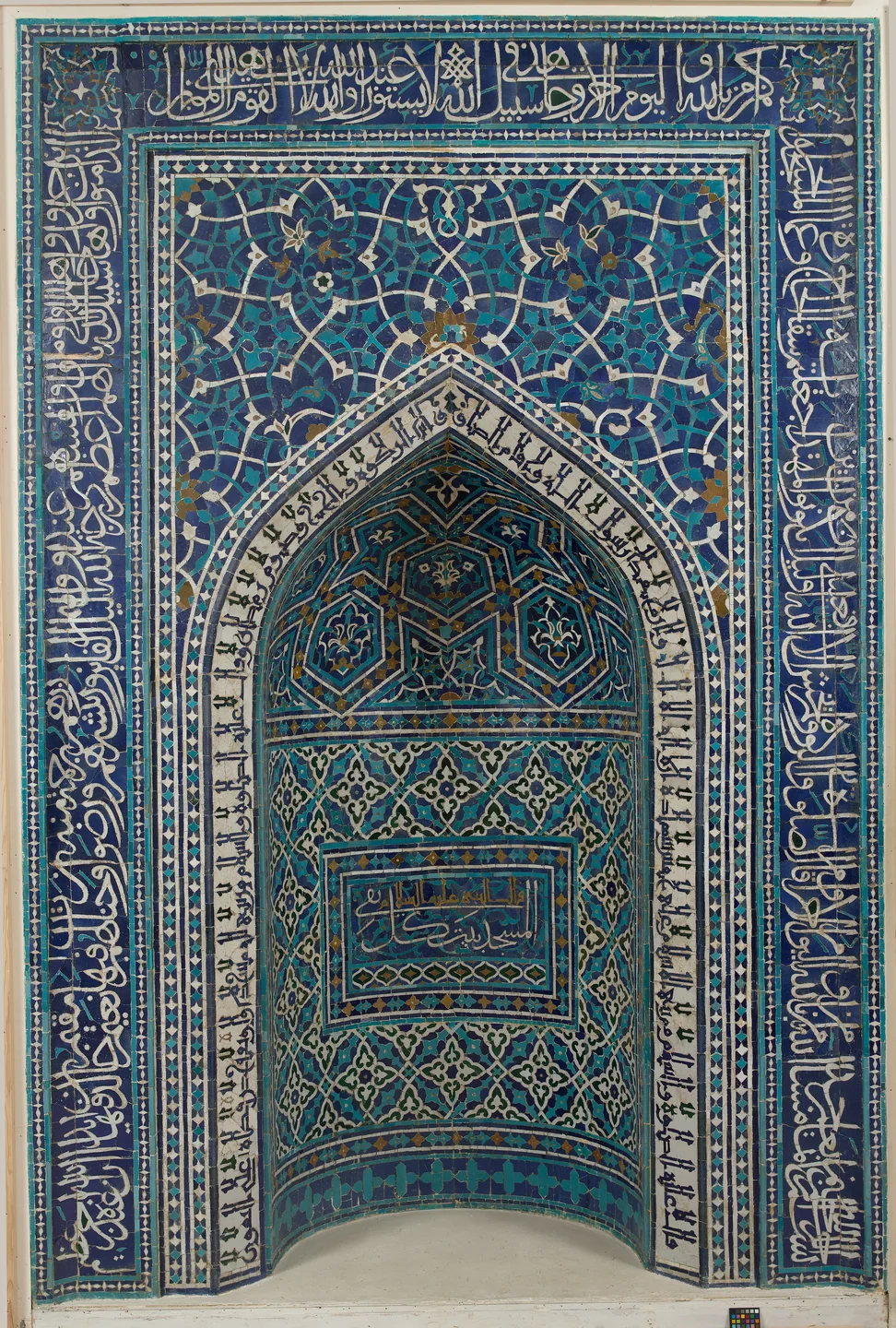
Section photograph · Tiled mihrab from the Madrasa Imami in Isfahan, Iran, dated 1354–55. Photo credit and license
The geometry of Islamic art
Geometric designs are prominent in many traditions of Islamic art. The Metropolitan Museum of Art explains how artists developed complex patterns using circles, stars, squares and other shapes, drawing on earlier artistic traditions as well. Islamic art also includes secular and figurative works.
While reading: Which patterns and objects does the museum describe?
The art of the written word
Calligraphy appears across Islamic artistic traditions, from manuscripts to ceramics, architecture and everyday objects. The Metropolitan Museum of Art and the Victoria and Albert Museum explore how writing can communicate meaning while also functioning as visual design.
While reading: What does the source say about form and function?
The mihrab: direction, craft and beauty
A mihrab is a feature of a mosque that indicates the direction of prayer toward Mecca. The Metropolitan Museum of Art preserves a tiled example from the Madrasa Imami in Isfahan, Iran. Its design brings together colored glazed tiles, patterns and inscriptions in a single architectural composition.
While reading: Look at the object’s place, period and purpose.
Instruments that connected the skies and daily life
The History of Science Museum at Oxford holds astronomical instruments made and used across the Islamic world. Astrolabes, quadrants and other devices show how observation, calculation and skilled metalwork were combined. The British Museum documents the early development of astrolabe scholarship in the Abbasid period.
While reading: What does the historical instrument help us understand?
Ibn al-Haytham and the study of light
Ibn al-Haytham was a scholar whose work on optics combined mathematical reasoning with observations and experiments. UNESCO’s account of his scientific method examines this contribution and the later circulation of his writings.
While reading: Which contribution is attributed to the scholar in the reference?
Art across cultural boundaries
The Metropolitan Museum of Art’s Islamic Art collection offers a starting point to explore objects made in different regions and periods. The category includes religious and secular objects, and the individual objects should be studied in their own historical contexts.
While reading: How does the evidence describe cultural exchange?